From 9,300 SAP materials to one product page
At Imprex, which products appeared in each catalogue was down to whoever did it. I wrote those rules down, turned them into a process that runs by itself every night from SAP to the PIM, and set out who decides what.
- Role
- Head of Garza and PIM owner, at Imprex
- Tools
- SAP, Oracle, SQL, Python, Sales Layer
- Result
- The sellable catalogue publishes itself every night from SAP, and thousands of obsolete product pages were flagged for removal
The problem
Imprex distributes third-party brands and has its own, Garza among them, and sells through several channels: the sales reps' tablets, the online catalogue and Shopify, among others. All of them draw on a PIM, Sales Layer, which in turn should draw on SAP.
In practice, deciding which products appeared in each catalogue was manual and depended on who did it. There was no rule saying "this product has the stock to be listed" or "this one is discontinued, take it out". Each brand manager applied their own judgement. You could see the result from outside: out-of-stock products still in the catalogue, new products taking weeks to appear, and thousands of pages in the PIM for products SAP had already retired.
Sales, who sold from that catalogue, and marketing, who maintained it, felt it most.
The technical problem was the small one. The hard part was that the rules weren't written down anywhere: what counts as a sellable product, what to do with one that's out of stock but sold two months ago, what happens when the same barcode has three SAP codes.
The solution
First, write the rules down. Before a line of code, I wrote down what makes a product listable: it belongs to a sector we sell, it's an item type that's sold to customers, it has a barcode, and it isn't a loose part of a display unit. Some of those rules I had to confirm with IT field by field, because the name of an SAP field doesn't always mean what it seems to.
Then, a layered funnel that runs by itself. Of the roughly 9,300 SAP materials in scope, the process decides every night:
- Listable: whether the product is relevant to any catalogue, from master data only. Everything that isn't sold to customers drops out here: services, billing items, material without a barcode.
- Live: whether it's available to sell, from actual planning, stock and the last twelve months of sales.
- Visible or hidden: a product that runs out of stock but has sold in the last year isn't deleted, it's hidden. That keeps the work marketing has put into its page (photos, copy, attributes), and it reappears when it's restocked.
- Publishing: live products go to the PIM every night. What dies is deleted from the PIM by comparing what's there with the list of live products.
Two design decisions that matter beyond the code. The calculation runs per barcode, not per SAP code, because one product can have several substitute SAP codes and to the customer it's a single product. And deletion has brakes: it won't act if the list to delete exceeds a cap or changes too much against the previous day, and by default it only simulates. An error upstream can't empty the catalogue overnight.
Finally, set out who decides what. Automation removes repetitive work, but it doesn't remove decisions. I wrote a governance document stating what each team does and doesn't do: IT maintains the SAP replicas and the server; logistics, the master data coming in; each brand manager, the enrichment of their pages and which channel each product goes to; and I, as PIM owner, the rules and the process. Without that split, incidents land with the wrong team and critical tasks fall to nobody.
The test came with the first complaints. Brand managers sent me a batch of products the process was about to remove and that, in their view, had to stay. I went through them one by one and only a couple were process errors. The rest were products flagged for deletion in SAP that the brand wanted to keep, products with no stock and no replenishment, one or two without a barcode, and a handful that were already in the catalogue. What I proposed to management wasn't a code change but a change to the workflow: a decision tree so each brand manager could see why a product isn't showing and who to go to, and a report per brand explaining each product's status in plain language.
The hardest part was the teams handling third-party brands. Many manufacturers have their own PIM, and those teams looked up the product page there instead of enriching it in ours. That made sense: the information already existed. But the manufacturer's PIM doesn't know what stock we have, what price we sell at or which channel each product goes to, and a distributor sells from its own catalogue, not the manufacturer's. With some brands it was fully resolved and their pages moved to being enriched in our PIM; with Garza, the brand I ran, too. With others it never got there.
Result
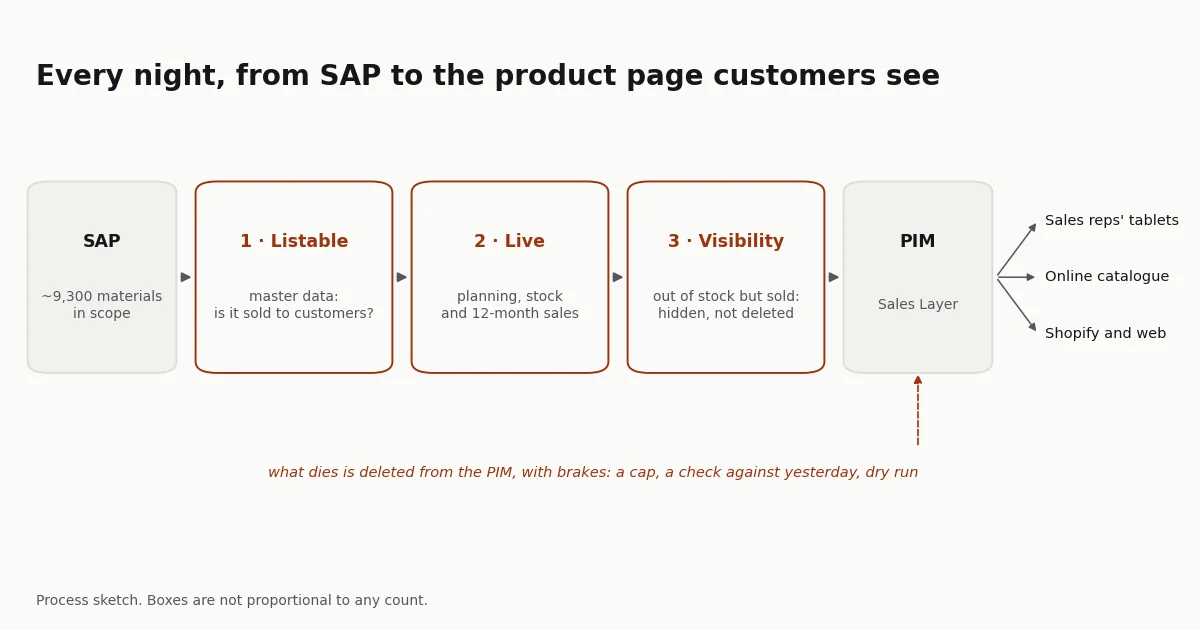
In April 2026 the process moved from my laptop to a company server and started running by itself every night: SAP dumps its tables, the process recalculates each product's status and publishes to the PIM, and a later step deletes what has died. Manual decisions about which products appear were gone for the whole sellable catalogue. When I left the company at the end of April, it was still running every night without anyone touching it.
The PIM became the source for the channels: the sales reps' tablets, the online catalogue and garza.es, Garza's Shopify website, which I set up to draw directly from the PIM. A page enriched once reaches all of them.
Printed catalogues stopped being put together by hand. With the EasyCatalog plugin, InDesign reads straight from the PIM, and I taught the designers to connect and to use markers and filters that apply the same business rules: those in the process that loads the PIM and those that live in the PIM itself. With that, a designer can produce the catalogue for a brand or a customer without asking anyone for the data.
What remained was deciding which product goes to which channel. One rule was already in production: some channels only want products with stock cover, so a product that isn't in the supply plan only goes in if it has at least three months of stock at last year's sales rate. Exclusivity by customer or by type of store I left specified as a cascade (first the product's rule, otherwise the brand's, otherwise the company's), with the rules in a table managed by the business so a new channel doesn't require touching code. When I left, it was waiting on the commercial decision about exclusivity.
Along the way, the manual process's blind spots came out: hundreds of materials without a barcode that inflated the count of listable products without ever reaching a catalogue, display-unit parts that aren't sold separately, and thousands of PIM pages for products that no longer existed.
The technical side was the easy part. What took most effort was writing down business rules that until then lived in people's heads, and getting each department to accept its share.
This experience is the basis of the catalogue service I now offer at Sapioverse (in Spanish).
How it's built, for anyone who wants the technical detail
- Source: SAP S/4HANA, replicated into Oracle every afternoon by IT.
- Layer 1, listable: a materialised view in Oracle with the master-data filters (sector, item type, category, barcode, display part and plant). A wall inside the query stops a non-listable product from reaching layer 2.
- Layer 2, live: a Python ETL that joins planning, stock and twelve months of sales per barcode, with substitute tables. Adapted to the S/4HANA migration, which moved stock movements to a different table.
- Publishing: a daily export to the PIM over FTP, and deletion through the API by comparing the PIM with the list of live products, with a cap, a check against the previous day and a dry run by default.
- Orchestration: a daily script with dependency ordering (calculation, view refresh, export) on a company Linux server, with cron.
- Tests: unit tests for the stock-cover calculation.
- Code: the original belongs to Imprex and isn't published. The rules are rewritten on a synthetic catalogue in acamposla/catalogo-vivo, with layer 1 in SQL, layer 2, the guarded reconciliation and 29 tests. Code and docs are in Spanish, with an English summary.
- Still pending when I left: the initial mass clean-up of the PIM, waiting on marketing's sign-off, and a third layer of per-channel catalogues, which needed a business decision on exclusivity.